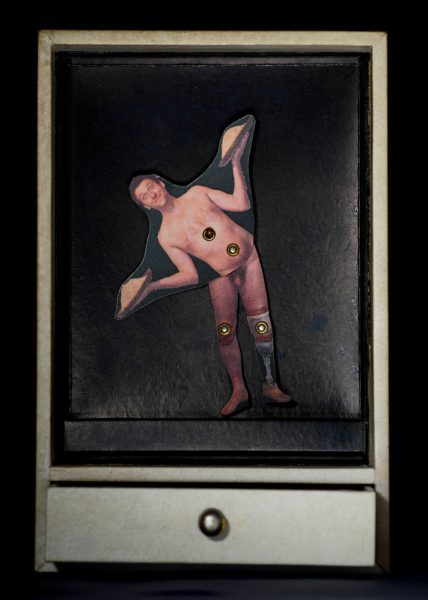
La Restitution
Ammonites, beautiful skulls, bones cast up by the earth, the habit of rummaging through rubbish bins—a ritual carried on since childhood—this attentiveness to living things and the traces they leave behind, the constant deciphering and resurrection of buried words, like taking a rubbing from a gravestone: these were the pillars of David Decamp’s artistic education. To this we might add being raised on a steady diet of Hara-Kiri, a way of keeping at a distance the rawness and violence of life and everything that threatens it, weakens it, and makes it unique and precious.
From there, we can follow the thread of a body of work deeply rooted in the singular experience of a childhood spent in the Jura—harsh, wild and timeless—where one can still discern “the traces of animals that rubbed against the stones, the church steps worn hollow by the believers who trod upon them, the never-cleaned stair rails that preserve the memory of the farmhand who climbed the stairs without washing…”
From this shadowy world, David Decamp draws the secrets of wear, polishing, and the passage of time over things and people, as well as his profound fascination with the mysteries of origins: primitive man, primeval forest, structure, bone. Themes imposed by life itself, which he explores with fierce intensity in Parcours inhospitalier, Delirium très bête, Clopin-Clopant, and Pyramide d’os.
In direct dialogue with cave painting, bas-relief, the ancient Egyptians, Aboriginal and Indigenous art, Art Brut, Brancusi and In Praise of Shadows, David Decamp, moving between forest and bone, relentlessly interrogates his own memory and presents us with works that assert themselves as so many silent, undeniable truths.
Brigitte David